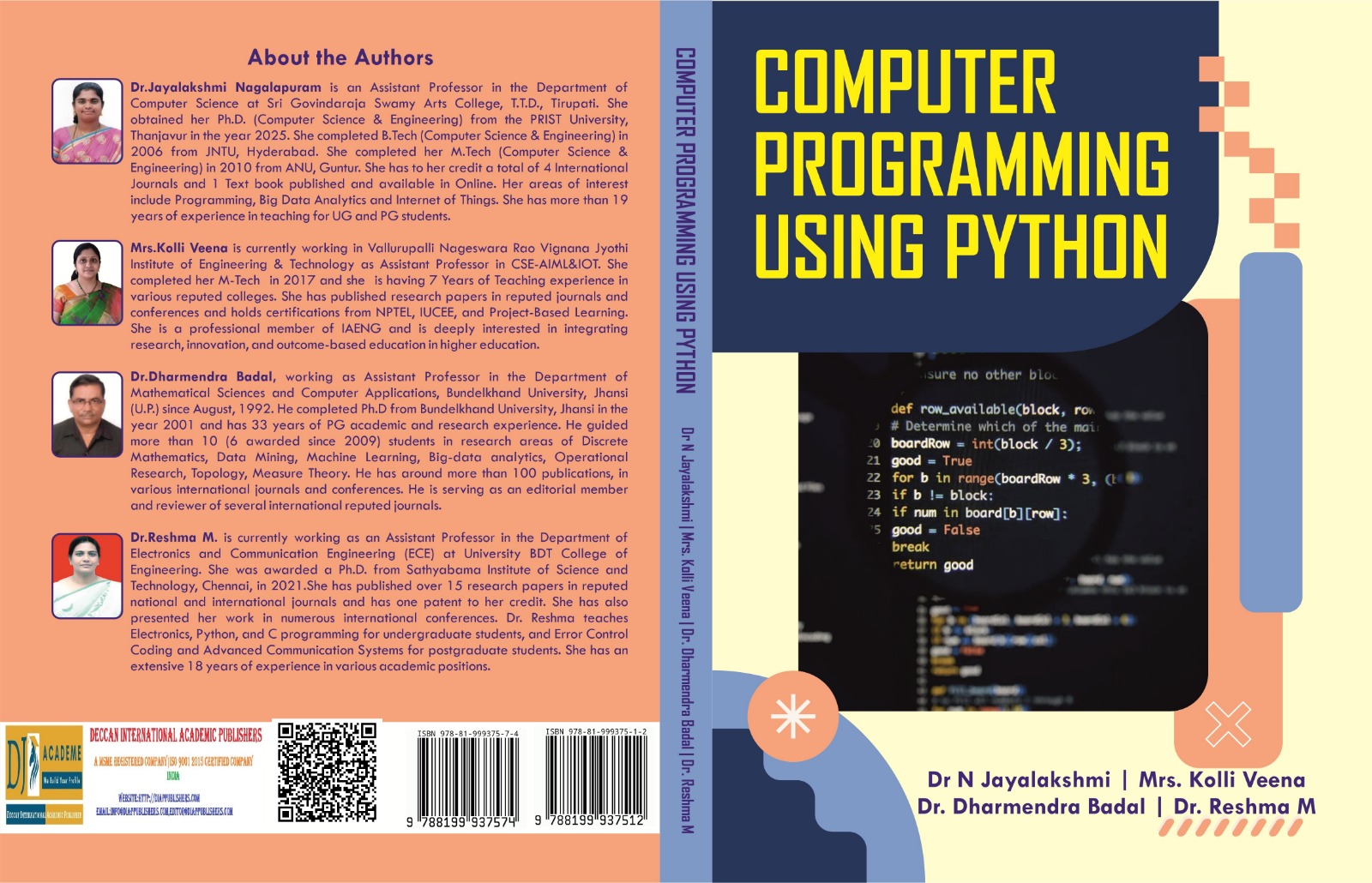
In an era driven by data, automation, artificial intelligence, and intelligent systems, programming has become a fundamental skill across disciplines. Among modern programming languages, Python has emerged as one of the most powerful, versatile, and beginner-friendly languages. Its simplicity, readability, and extensive ecosystem make it an ideal choice for students, researchers, engineers, and professionals alike.
The book Computer Programming Using Python is a collaborative effort by distinguished academicians and industry experts who share a common vision—to present Python programming in a structured, clear, and application-oriented manner. As a multi-author volume, this book brings together diverse academic perspectives, practical insights, and pedagogical approaches to ensure comprehensive coverage of both foundational and advanced topics.
Purpose and Vision
The primary objective of this book is to provide:
A strong conceptual foundation in programming principles
Step-by-step explanations of Python syntax and constructs
Logical problem-solving approaches
Practical examples and real-world applications
Exposure to modern libraries and tools
The contributors have carefully designed each chapter to bridge the gap between theoretical concepts and practical implementation. Emphasis is placed on clarity, structured progression, and hands-on learning.
Structure of the Book
The book is systematically organized to guide learners from basic to advanced levels:
Fundamentals of Programming and Python Basics
Introduction to algorithms, flowcharts, Python environment setup, variables, data types, operators, and input/output operations.
Control Structures and Functions
Decision-making statements, loops, functions, recursion, and modular programming concepts.
Data Structures in Python
Lists, tuples, sets, dictionaries, string manipulation, and file handling techniques.
Object-Oriented Programming (OOP)
Classes, objects, constructors, inheritance, polymorphism, encapsulation, and exception handling.
Advanced Python Concepts
Modules, packages, regular expressions, GUI programming basics, and working with external libraries.
Scientific and Data-Oriented Programming
Introduction to libraries such as NumPy and Pandas, data analysis basics, and visualization concepts.
Application-Oriented Programming
Real-world mini-projects, problem-solving case studies, and best coding practices.
Each chapter includes illustrative examples, solved programs, practice exercises, review questions, and programming assignments to strengthen understanding.
Pedagogical Features
Clear explanations with algorithmic thinking
Flowcharts and logical diagrams
Sample programs with output
Debugging tips and common error discussions
Exercise sets ranging from basic to advanced level
Mini-projects for experiential learning
Intended Audience
This book is designed for:
Undergraduate and postgraduate students in Computer Science, Engineering, and related disciplines
Faculty members teaching programming courses
Beginners seeking structured learning
Professionals transitioning into programming or data-related fields
No prior programming experience is required for the initial chapters, while later chapters provide sufficient depth for advanced learners.
A Collaborative Academic Effort
As a multi-author book, each contributor has brought expertise from their specialization areas—software development, data science, artificial intelligence, education technology, and systems programming. The diversity of viewpoints enriches the content and ensures academic rigor combined with practical relevance.
We sincerely hope that this book will serve as a reliable companion for learners embarking on their programming journey. Programming is not merely about writing code—it is about developing logical thinking, creativity, and problem-solving skills. Python, with its elegant syntax and powerful capabilities, provides the perfect platform to cultivate these skills.
We extend our gratitude to all contributing authors, reviewers, academic colleagues, and students whose feedback has helped refine this work. We also thank our families and institutions for their constant encouragement and support.
May this book inspire readers to explore, experiment, and innovate through Python programming.
Reviews
There are no reviews yet.