
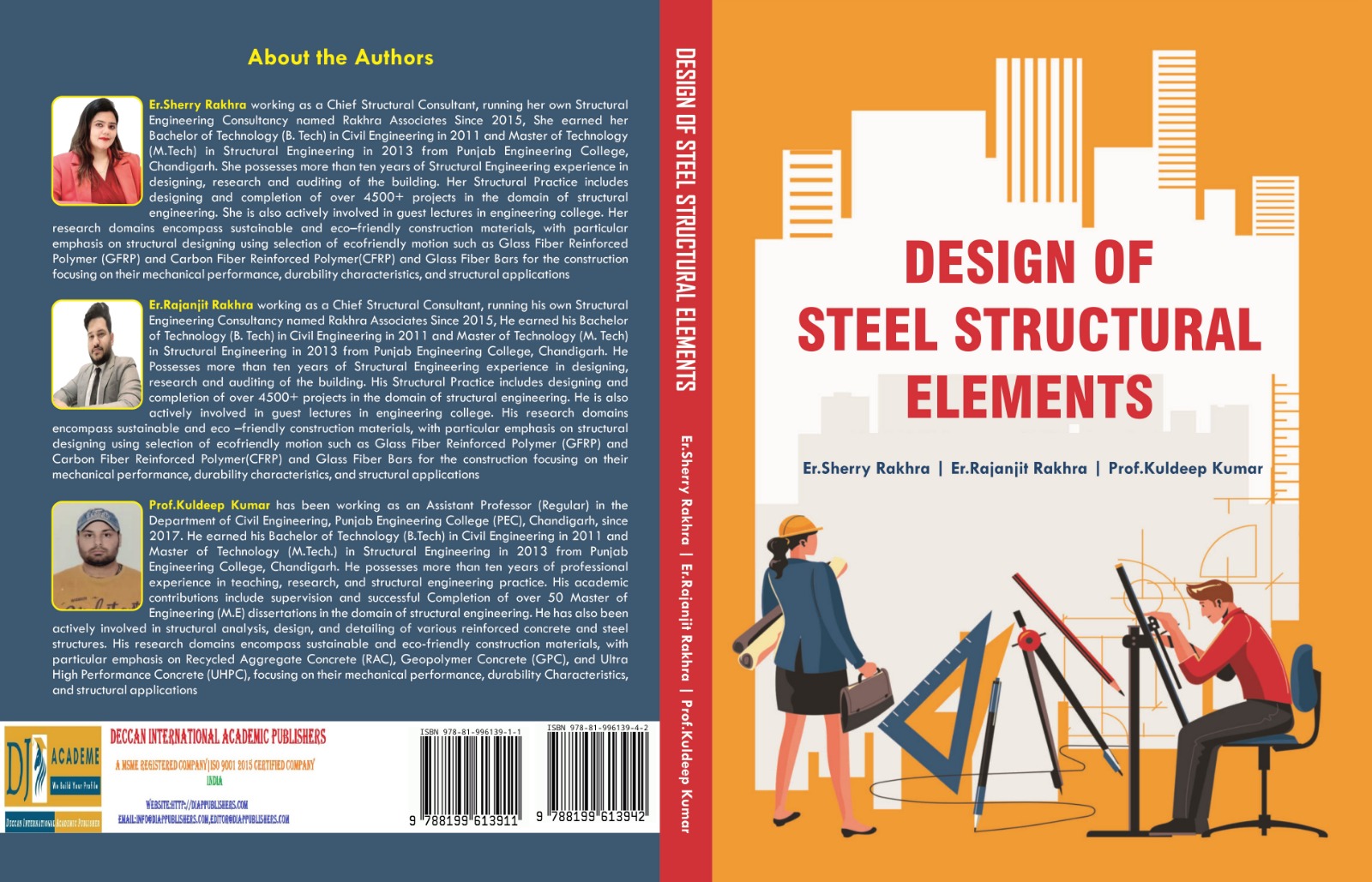
The rapid pace of urbanization and industrial growth across the globe has significantly increased the demand for safe, economical, and sustainable structural systems. Steel, owing to its high strength-to-weight ratio, durability, ductility, and adaptability, has emerged as one of the most preferred construction materials for modern infrastructure. In this context, the book Design of Steel Structural Elements is conceived to serve as a comprehensive and authoritative resource for students, academicians, practicing engineers, and researchers in the field of civil and structural engineering.
This multi-author volume brings together the collective expertise and practical experience of distinguished contributors from academia and industry. Each chapter has been carefully authored to present both theoretical foundations and practical design methodologies, ensuring alignment with current design philosophies, codal provisions, and real-world engineering practices. The book systematically covers fundamental concepts of steel structures, material properties, limit state design philosophy, and the behavior of structural members under various loading conditions.
Special emphasis is placed on the design of key steel structural elements such as tension members, compression members, beams, beam-columns, connections, and industrial components. Detailed explanations, step-by-step design procedures, worked examples, and illustrative diagrams are provided to enhance conceptual clarity and problem-solving skills. Wherever appropriate, the text integrates references to relevant national and international design standards, enabling readers to understand both compliance requirements and best engineering practices.
Recognizing the evolving needs of engineering education and professional practice, this book also addresses contemporary topics such as structural stability, serviceability considerations, fabrication and erection aspects, and the role of steel structures in sustainable construction. The content is structured in a pedagogical manner, making it suitable for undergraduate and postgraduate curricula, competitive examinations, and professional certification programs.
As a collaborative academic effort, this book reflects the dedication and scholarly contribution of all the authors, reviewers, and editors involved. Their collective vision has been to create a reliable, student-friendly, and industry-relevant text that bridges the gap between theory and practice in steel structural design.
We sincerely hope that Design of Steel Structural Elements will serve as a valuable reference and learning companion, inspiring readers to develop sound structural judgment and contribute effectively to the design of safe and resilient steel structures.

Reviews
There are no reviews yet.