
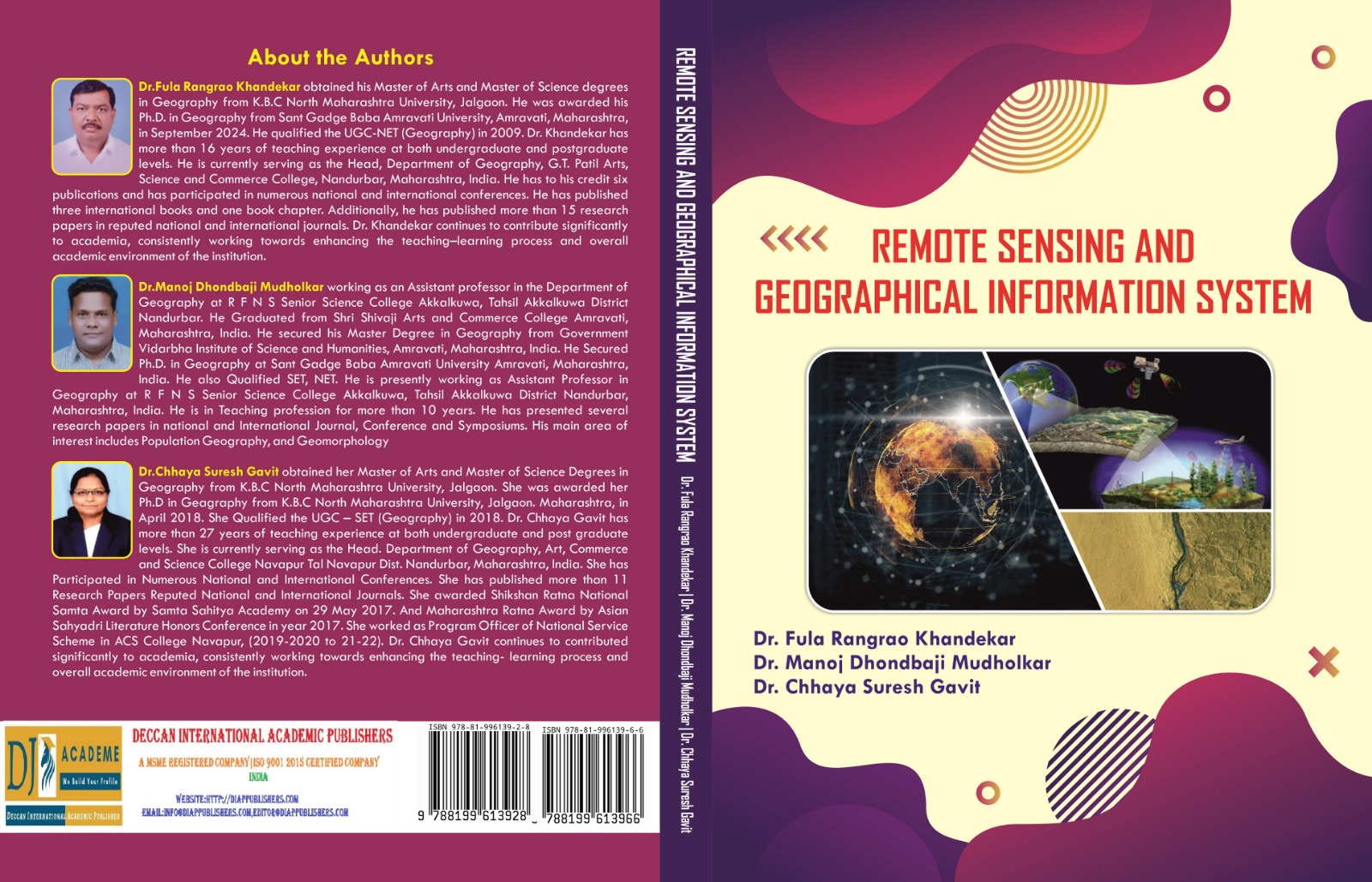
The rapid advancement of geospatial technologies has transformed the way we observe, analyze, and manage the Earth’s resources. Remote Sensing and Geographical Information System (GIS) have emerged as indispensable tools in understanding complex spatial phenomena, supporting informed decision-making across diverse domains such as environmental monitoring, urban planning, agriculture, disaster management, climate studies, natural resource management, and defense applications. This book has been conceived with the objective of providing a comprehensive, structured, and application-oriented understanding of these powerful technologies.
This multi-author volume brings together the collective expertise of academicians, researchers, and practitioners who possess extensive experience in teaching, research, and real-world geospatial applications. Each contributing author has enriched the book with insights drawn from both theoretical foundations and practical exposure, ensuring that the content remains relevant, contemporary, and aligned with current academic curricula and industry requirements.
The book systematically covers the fundamental principles of remote sensing, including electromagnetic radiation, satellite platforms, sensors, image interpretation, and data preprocessing techniques. It further delves into the core concepts of GIS such as spatial data models, georeferencing, database design, spatial analysis, and visualization. Emphasis has been placed on integrating remote sensing data with GIS for advanced analysis and problem-solving, supported by illustrative diagrams, case studies, and real-world examples.
Special attention has been given to emerging trends such as geospatial modeling, web GIS, GPS integration, and applications of geospatial technologies in smart cities, precision agriculture, and sustainable development. The content is presented in a clear and logical manner, making it accessible to undergraduate and postgraduate students of engineering, science, geography, environmental studies, and planning, while also serving as a valuable reference for researchers and professionals.
We sincerely hope that this book will serve as a reliable academic resource, foster analytical thinking, and inspire readers to explore innovative applications of Remote Sensing and GIS. The editors and authors are grateful to all reviewers, colleagues, and institutions whose support and encouragement made this collaborative effort possible. Constructive feedback and suggestions from readers are always welcome, as they will help enhance future editions of this work.
Reviews
There are no reviews yet.