
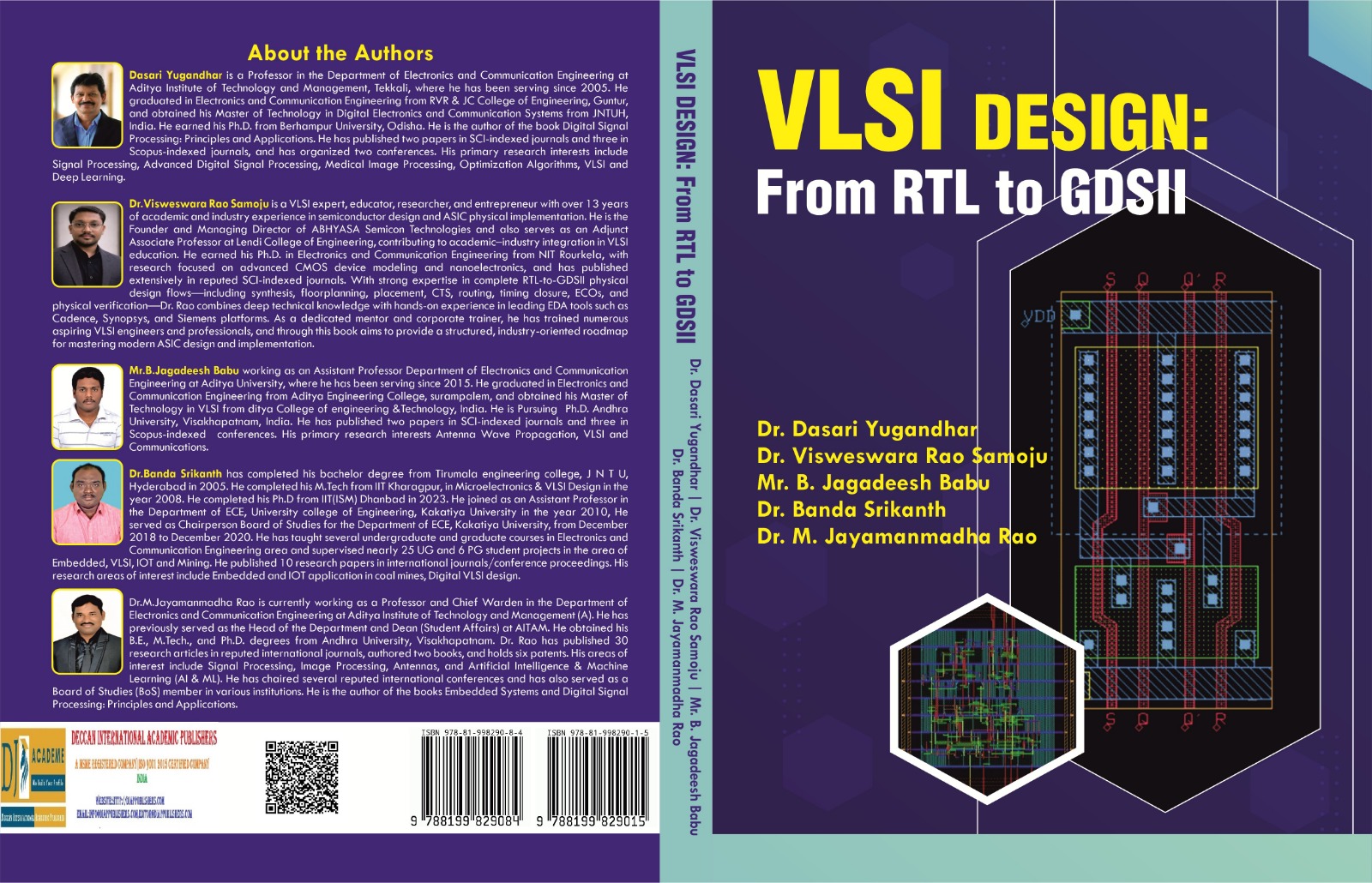
The field of Very Large Scale Integration (VLSI) design has undergone remarkable transformation over the past few decades, evolving from transistor-level handcrafted layouts to highly automated design flows that integrate abstraction, verification, optimization, and manufacturing readiness. Modern semiconductor systems now demand billions of transistors, nanometer technologies, strict power budgets, and aggressive time-to-market targets. In this environment, designers must not only understand circuits and logic, but also master methodologies that span the complete design continuum—from Register Transfer Level (RTL) modeling to physical implementation and final GDSII tape-out.
VLSI Design: From RTL to GDSII has been conceived to provide a comprehensive, practice-oriented, and academically rigorous guide that bridges this entire spectrum. Unlike many texts that treat design stages in isolation, this book presents the VLSI flow as an integrated ecosystem where architecture, coding style, synthesis constraints, verification strategy, timing closure, physical design, and sign-off checks are deeply interconnected. Decisions made early at the RTL stage profoundly affect power, performance, area, and manufacturability at later stages. Recognizing this interdependence is central to successful chip design.
This volume is the result of a collaborative effort by multiple authors drawn from academia, industry, and research laboratories. Each contributor brings specialized expertise in areas such as RTL design, HDL modeling, functional verification, logic synthesis, static timing analysis, floorplanning, placement and routing, low-power techniques, signal integrity, design for testability, and physical verification. The collective experience of the contributors ensures that the material reflects both theoretical foundations and current industry practices.
The book is structured to guide readers progressively through the complete VLSI design lifecycle:
• RTL design methodologies using Verilog/SystemVerilog
• Functional verification, assertions, and coverage metrics
• Logic synthesis and constraint-driven optimization
• Static timing analysis and timing closure
• Physical design: floorplanning, placement, clock tree synthesis, and routing
• Power optimization and low-power design strategies
• Signal integrity challenges such as crosstalk, IR drop, and electromigration
• Design for testability and reliability considerations
• Physical verification including DRC, LVS, and ERC
• GDSII generation, tape-out procedures, and final sign-off
Throughout the text, emphasis is placed on real-world workflows, tool-based methodologies, practical examples, and case studies. Design guidelines, best practices, and common pitfalls are highlighted to help students and engineers translate theory into effective implementation. Wherever appropriate, the book integrates modern EDA tool flows and industry-standard practices to ensure relevance to contemporary chip development environments.
This book is intended for:
• Undergraduate and postgraduate students in VLSI, Microelectronics, and Electronics Engineering
• Researchers seeking a holistic understanding of design automation
• Practicing engineers and professionals working in ASIC/SoC design
• Faculty members adopting a complete RTL-to-GDSII curriculum
We sincerely hope that this text serves as both a learning companion and a professional reference, enabling readers to develop not only technical competence but also a system-level perspective on integrated circuit design.
The editors and authors express their gratitude to colleagues, reviewers, students, and industry experts whose insights and feedback have significantly improved the quality of this work. We also acknowledge the rapid evolution of semiconductor technologies and encourage readers to view this book as a foundation upon which future innovations will build.
It is our aspiration that VLSI Design: From RTL to GDSII empowers the next generation of designers to create efficient, reliable, and scalable silicon systems that shape the technologies of tomorrow.
-20%
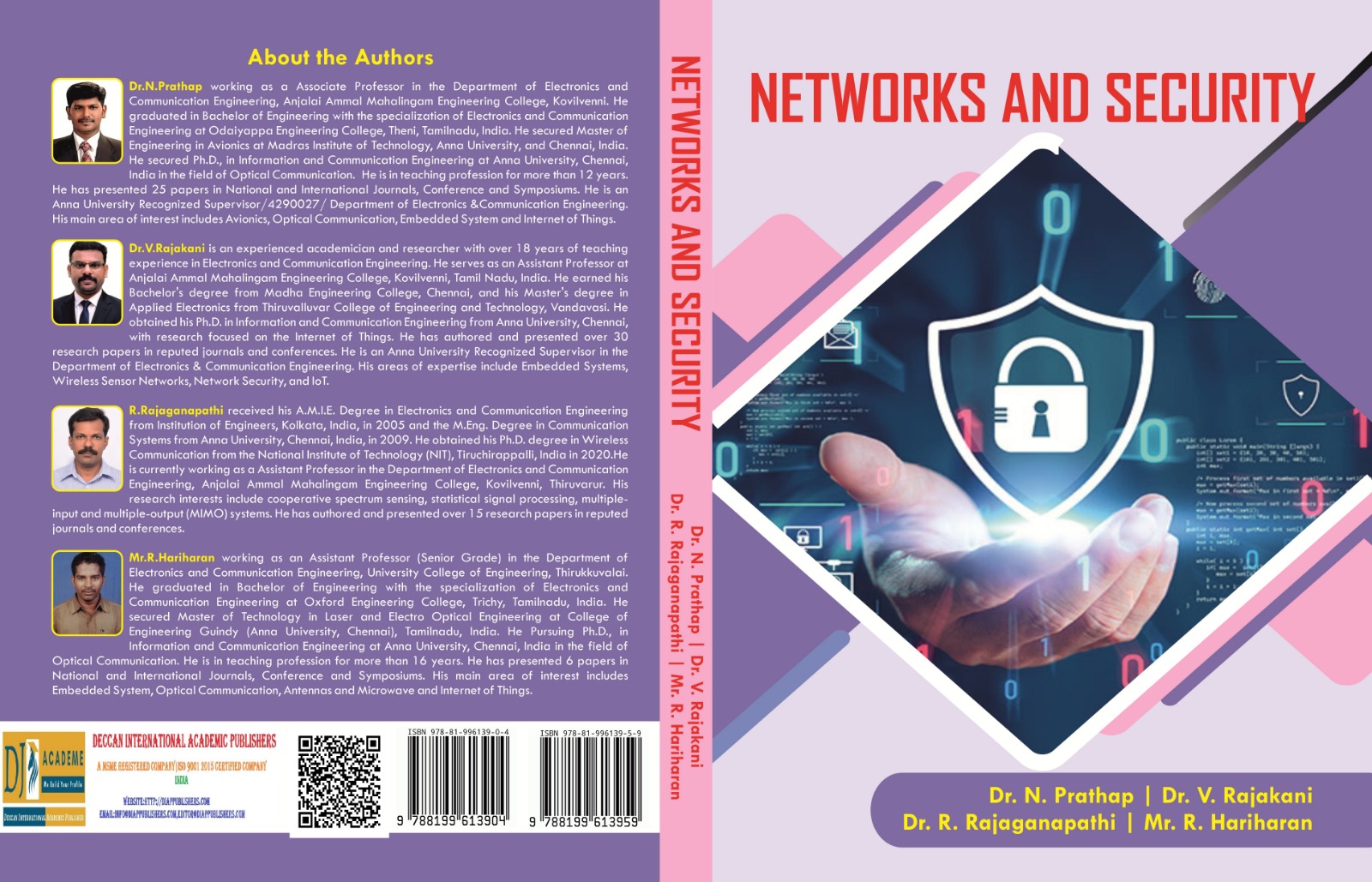
Networks and Security BY Dr. N. Prathap, Dr. V. Rajakani, Dr. R. Rajaganapathi, Mr. R. Hariharan
Original price was: ₹999.00.₹899.00Current price is: ₹899.00.

Using IBM SPSS Statistics
Original price was: ₹65.00.₹42.00Current price is: ₹42.00.
VLSI Design: From RTL to GDSII by Dr. Dasari Yugandhar, Dr. Visweswara Rao Samoju, Mr. B. Jagadeesh Babu, Dr. Banda Srikanth, Dr. M. Jayamanmadha Rao
Original price was: ₹999.00.₹799.00Current price is: ₹799.00.
Description
Additional information
| Weight | 0.5 kg |
|---|---|
| Dimensions | 21 × 30 × 5 cm |
Reviews (0)
Shipping & Delivery



Reviews
There are no reviews yet.