
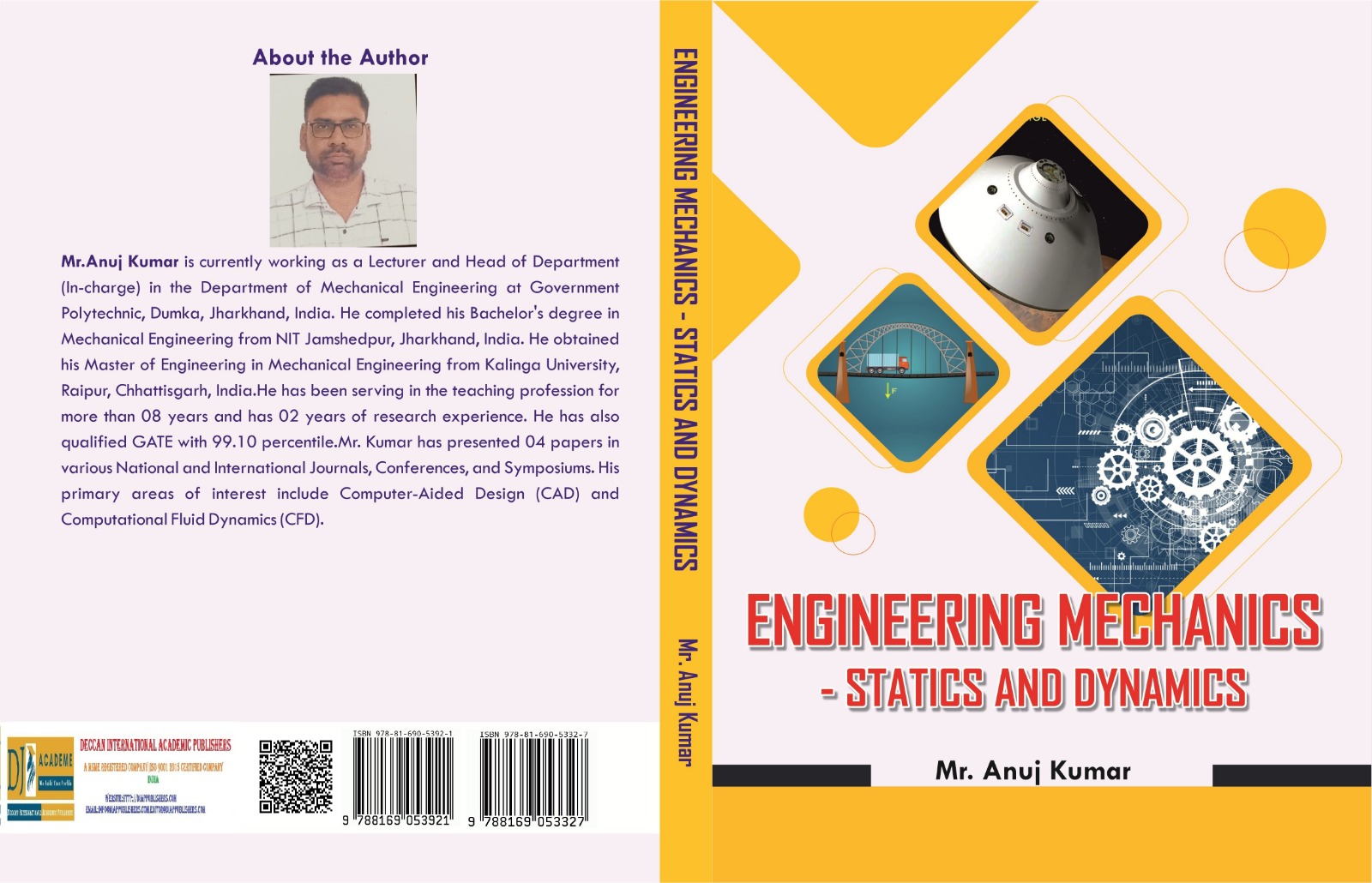

Engineering Mechanics forms the fundamental foundation of all engineering disciplines. It provides the essential principles required to understand how forces act on bodies and how those bodies respond to such forces. From the stability of massive structures and bridges to the motion of vehicles, aircraft, machines, and robotic systems, the principles of statics and dynamics govern the behavior of engineered systems in the real world.
This multi-author volume, Engineering Mechanics: Statics and Dynamics, has been developed with the objective of presenting a comprehensive, clear, and application-oriented treatment of the subject. The collaborative effort of contributing authors—each bringing academic expertise, research experience, and classroom insights—has enriched this book with diverse perspectives while maintaining conceptual coherence and systematic organization.
The book is carefully structured into two major parts:
Statics, which deals with bodies in equilibrium, focusing on force systems, moments, couples, trusses, frames, centroids, and moments of inertia.
Dynamics, which examines bodies in motion, covering kinematics, kinetics, work and energy principles, impulse and momentum, and rigid body motion.
Special emphasis has been placed on:
Clear explanation of fundamental laws, including Newton’s laws of motion
Systematic problem-solving methodology
Step-by-step derivations and logical progression of concepts
Numerous solved examples and practice problems
Real-world engineering applications
The contributors have collectively ensured that each chapter blends theoretical foundations with practical engineering relevance. Modern pedagogical approaches, including structured examples, conceptual questions, and application-based problems, have been incorporated to enhance understanding and analytical skills.
Recognizing that Engineering Mechanics often serves as the first core engineering subject for students, particular care has been taken to present the material in a precise yet accessible manner. Mathematical rigor is maintained while ensuring clarity of explanation. Diagrams, free-body illustrations, and systematic derivations are extensively used to develop strong conceptual visualization.
This book is intended for undergraduate engineering students across disciplines—Mechanical, Civil, Electrical, Aerospace, Mechatronics, and related fields. It will also serve as a valuable reference for diploma students, competitive examination aspirants, educators, and practicing engineers seeking to revisit foundational principles.
The collaborative spirit of this multi-author work reflects our shared commitment to academic excellence and quality technical education. We sincerely hope that this book will not only help students master the principles of statics and dynamics but also inspire them to appreciate the elegance, logic, and practical power of engineering mechanics.
We express our gratitude to academic peers, reviewers, students, and well-wishers whose feedback and encouragement contributed to the successful completion of this work.
May this book serve as a strong stepping stone in the engineering journey of every reader.
— The Authors








Reviews
There are no reviews yet.